India's Electric Two-Wheeler Revolution
For millions of Indian households, the two-wheeler is more than just a recreational vehicle; it is everyday transportation. Motorcycles and scooters carry people to work and school, support small businesses and delivery services, and provide affordable mobility through some of the world’s most congested cities. In India, the two-wheeler is equivalent to the family car in the United States.
With that in mind, India’s two-wheeler market is enormous. More than 22 million motorcycles and scooters are sold annually, with motorcycles still accounting for the majority of the market. Scooters, however, have been gaining share, particularly in urban areas, where their ease of use, storage and convenience make them increasingly popular. Rising incomes, urbanization and worsening traffic congestion continue to support demand for personal and nimble mobility.
Now, this vast market is beginning to electrify. Electric two-wheeler sales have grown from a small base only a few years ago to more than a million units annually; better batteries, lower operating costs, improving charging infrastructure and government policy have accelerated adoption. But the change is about more than replacing gasoline with electricity. Electrification is also transforming the two-wheeler itself. They are going from a largely mechanical product into an increasingly connected, software-driven vehicle.
A Market Moving Quickly from Niche to Mainstream
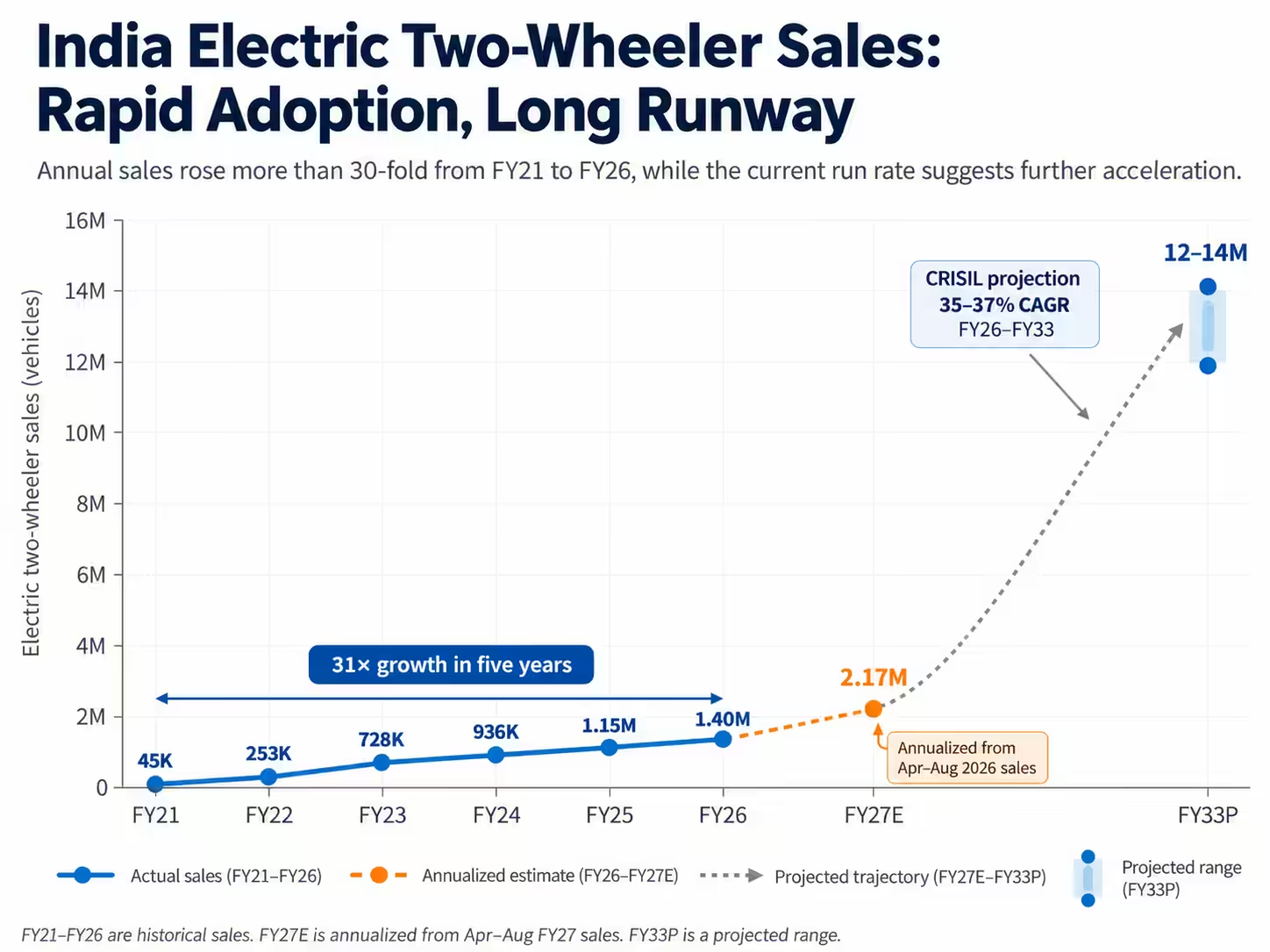
India’s shift toward electric two-wheelers has happened remarkably quickly. In fiscal 2021, only about 45,000 electric two-wheelers were sold - roughly 0.3% of the overall two-wheeler market. In fiscal 2026, annual sales rose to 1.4 mn units, a 31-fold increase in five years.
The pace has accelerated this year. During the first five months of fiscal 2027 (April - August 2026), Indians registered 903,000 electric two-wheelers, up 70% from the same period a year earlier. July became the first month in which electric two-wheeler sales crossed 200,000 units.
Penetration is the more important number when thinking about the runway ahead. Despite the extraordinary growth of the past five years, electric two-wheelers accounted for only about 10.7% of total two-wheeler sales in August 2026. In other words, the industry has already scaled rapidly while still serving only a relatively small share of the overall market.
That combination, fast adoption and low penetration, is what makes the opportunity particularly interesting. Electric scooters have moved from a niche product to a meaningful part of India’s mobility market in just a few years, yet the vast majority of two-wheelers sold each year are still gasoline-powered.
Why Adoption Is Accelerating
Several forces have coalesced to push electric two-wheelers from the margins toward the mainstream.
The economics have become increasingly compelling. Electricity costs far less per kilometer than gasoline, while electric drivetrains have fewer moving parts and generally require less routine maintenance. For riders who use a scooter every day, these savings can make the total cost of ownership meaningfully lower, despite similar upfront purchase prices. Falling battery costs, higher production volumes and greater localization have also narrowed the initial price gap with gasoline scooters.
Beyond the economics, the product has improved as well. Better batteries, motors and battery-management systems have increased range, performance and reliability, eliminating many of the compromises associated with early electric scooters. Charging for these vehicles is less challenging than it is for electric cars. A typical scooter carries only a 3 - 4 kWh battery, so for many riders an overnight charge at home is sufficient for the next day’s travel. Public infrastructure is expanding as well; Ather, for example, began building a dedicated two-wheeler fast-charging network, the Ather Grid, years before the market reached meaningful scale.
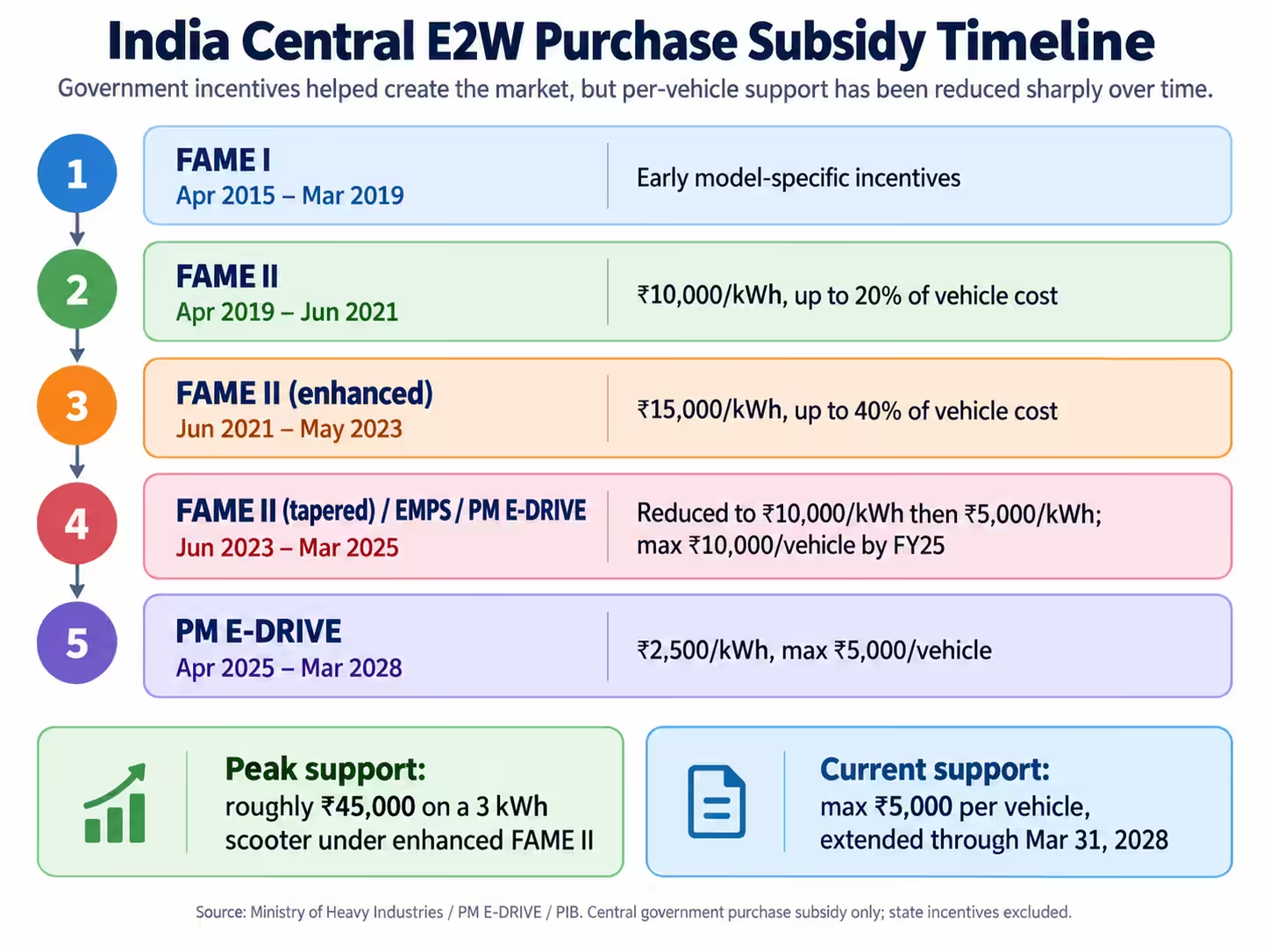
Government incentives have played an important role in creating the category, but the market is becoming progressively less dependent on them. Under the enhanced FAME II program in 2021, a 3 kWh scooter could qualify for roughly ₹45,000 of support. Today, under PM E-DRIVE, the central subsidy is capped at only ₹5,000 per vehicle. Yet sales have continued to rise sharply. That suggests improving economics, better products and growing consumer acceptance are increasingly doing more of the work.
Finally, India’s traditional two-wheeler manufacturers, TVS, Bajaj and Hero, have entered the market in force, bringing trusted brands, manufacturing scale, dealer networks and service infrastructure. Their participation has moved electric scooters from an unfamiliar technology toward a credible everyday alternative.
But electrification has also changed something more fundamental. Replacing the internal-combustion engine with batteries, motors, sensors and electronic controllers has created a new vehicle architecture, one in which software can increasingly control how the scooter performs, communicates and interacts with its rider. That is where Ather’s story becomes particularly interesting. The scooter is no longer just becoming electric. It is becoming a computing platform.
Ather: When the Scooter Became a Computer
The company that perhaps best illustrates this transformation is Ather Energy. Founded in 2013 out of IIT Madras, Ather approached the scooter less like a traditional motorcycle manufacturer and more like a technology company building an integrated hardware-and-software product.
When Ather launched its first product, the Ather 450, in 2018, it became the first electric two-wheeler in India to offer a touchscreen dashboard with built-in navigation, internet connectivity and cloud integration. It also introduced over-the-air software updates, allowing the scooter to gain new functionality after it had already been sold. Rather than wait for public infrastructure to develop, Ather also began building its own fast-charging network.
At the heart of this connected platform is AtherStack, the company’s proprietary software architecture developed in-house to power its scooters. It is far more than an infotainment layer. AtherStack links the scooter, dashboard, mobile app, cloud infrastructure, charging network and accessories into a single system. Google Maps runs directly on the dashboard; over-the-air updates can add new features; and software increasingly manages core vehicle functions such as regenerative braking, traction control and diagnostics.
The sophistication has continued to increase. Ather’s software can detect a crash and alert emergency contacts, remotely immobilize a stolen scooter, and use data gathered from its connected fleet to warn riders about potholes, speed breakers and rough roads. Its Pothole+ feature can even incorporate road quality into route selection, recommending a smoother journey rather than simply the shortest one.
The ecosystem extends beyond software. Ather designs its own battery packs, battery-management system and much of the associated electronics. This allows them to monitor charging, temperature, power delivery and battery health. Its charging network connects riders to thousands of compatible charging points across India.
Its Halo smart helmet connects with the scooter and phone for music, calls, voice controls and rider-to-rider communication, while accessories such as tire-pressure sensors feed additional information back into the vehicle.
The significance is not any one feature. It is the way the scooter, battery, software, charging network, smartphone and accessories increasingly operate as one connected system—and the fact that the product can continue improving after it leaves the factory.
To an American reader familiar with Tesla, some of this may sound familiar. What is less familiar is finding this level of computing and connectivity in everyday transportation costing roughly $1,000–$1,500.
The digital layer is also beginning to matter economically. Software, charging and services already contribute roughly 14% of Ather’s operating revenue, creating revenue streams that look different from the traditional economics of selling a scooter alone. In the first quarter of fiscal 2027, Ather sold more than 83,000 scooters, nearly doubled operating revenue and reported positive EBITDA for the first time since listing.
The next test is whether Ather can take this technology to a much broader customer base. In August 2026 it introduced the Konarc, built on a new lower-cost platform and priced from about ₹100,000, or roughly $1,100. That puts Ather directly into the largest part of India’s electric-scooter market, and into more intense competition with TVS, Bajaj and Hero.
The question is no longer whether sophisticated software can be built into an electric scooter. Ather has demonstrated that it can. The more important question is whether that technology can be delivered profitably at the price points required for mass adoption in India, and eventually across the developing world.
Ather’s 2026 Community Day provides a quick visual look at how the company is extending the electric scooter into a broader technology platform encompassing the vehicle, battery, charging and ownership experience.
Watch the highlights of the community day here:
Ather Konarc and everything launched at #AtherCommunityDay26 in less than 20 mins
Built in India, for a Much Larger Market
India’s electric two-wheeler opportunity may ultimately extend far beyond its domestic market.
The country already has one of the world’s largest and most cost-competitive two-wheeler manufacturing ecosystems. Indian manufacturers export more than five million motorcycles and scooters annually, with many of those vehicles sold across Africa, Asia and Latin America. In these markets, as in India, the two-wheeler is often the most practical form of personal transportation.
That matters because India has spent decades solving a very specific engineering problem: how to build vehicles that are affordable, fuel-efficient, durable and easy to service, while operating in heat, dust, poor road conditions and heavy daily use. Those same constraints exist across much of the developing world.
India’s established manufacturers also bring something newer EV companies elsewhere may lack: distribution, service networks, supplier relationships and brand recognition across many emerging markets. Bajaj, TVS and Hero already sell conventional two-wheelers internationally. If electric models gradually replace gasoline-powered scooters and motorcycles, these companies may be able to extend existing commercial networks rather than build them from scratch.
At the same time, newer companies such as Ather are pushing the technological frontier in batteries, software, connectivity and vehicle intelligence. The result is an increasingly unusual combination: sophisticated electric vehicles being developed inside one of the world’s lowest-cost mass-market two-wheeler ecosystems.
For now, electric two-wheeler adoption outside a handful of Asian markets remains relatively low. But the underlying mobility need is enormous. Hundreds of millions of consumers across emerging economies require affordable personal transportation, and many of those markets already depend heavily on motorcycles and scooters.
India’s opportunity may therefore be larger than electrifying its own two-wheeler fleet. It may be to develop the affordable electric two-wheeler platform for much of the developing world.
Why This Matters
India’s electric two-wheeler industry is still early in its development, but the direction of travel is becoming clearer. A market that barely existed five years ago is now selling more than a million vehicles annually, and adoption continues to accelerate.
What makes the opportunity particularly interesting is the combination of scale and capability. India already has a vast domestic two-wheeler market, a deeply developed low-cost manufacturing base and decades of experience exporting affordable vehicles to emerging economies. Electrification is now adding a new layer of capability in batteries, electronics, software and connected services.
Companies such as Ather show how quickly the product itself is evolving. The scooter is no longer simply a mechanical vehicle powered by a different energy source. It is becoming a connected platform that can improve through software, learn from fleet data and integrate with charging networks, mobile applications and accessories.
For investors, the long-term opportunity may therefore be larger than rising EV penetration within India. If Indian manufacturers can combine their historical advantages in cost and manufacturing with increasingly sophisticated electric technology, they could be well positioned to serve a much broader market across the developing world.
The shift to electric two-wheelers is changing how India moves while also creating a new generation of Indian mobility companies with relevance far beyond India itself.