India Is Becoming the World’s Outsourced Research and Manufacturing Partner
For much of the past three decades, outsourcing was primarily about cost. Companies designed and developed products in the United States or Europe and transferred labor-intensive manufacturing to lower-cost locations.
That model is changing.
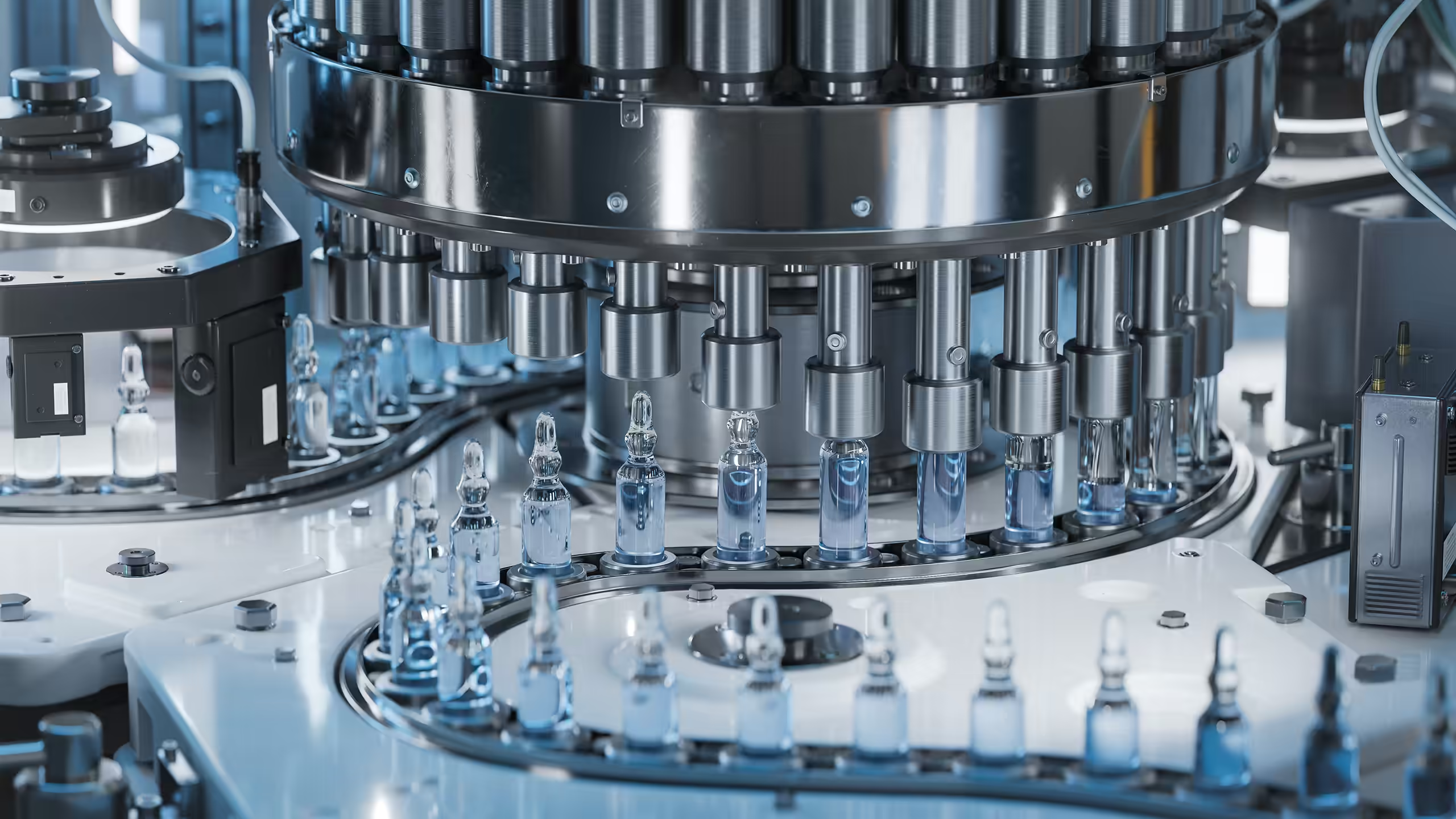
In the pharmaceutical industry, the most valuable outsourcing relationships increasingly involve far more than manufacturing an established product at a lower price. Global pharmaceutical and biotechnology companies — often referred to collectively as biopharma companies — are relying on external partners to help discover new molecules, develop commercially viable production processes, navigate regulatory requirements and manufacture increasingly complex therapies.
The outsourced service provider is evolving from a vendor into a scientific and manufacturing partner. India is increasingly well positioned to play that role.
Biopharma Outsourcing Is Becoming Structural
Developing a new drug is an unusually difficult and capital-intensive undertaking. Bringing a medicine from discovery to commercialization generally takes more than ten years, requires over $1 billion of investment and carries a high probability of failure.
At the same time, drug development is becoming more technically demanding. The industry is moving beyond conventional small-molecule medicines towards more complex therapies, including peptides, antibody-drug conjugates, oligonucleotides and cell and gene therapies. Each new modality requires specialized scientific knowledge, equipment, manufacturing processes and regulatory expertise.
These economics make it increasingly impractical for every biopharma company to maintain every required capability internally — particularly when much of the infrastructure may be dedicated to drugs that never reach the market.
The response has been a gradual shift towards asset-light operating models. Biopharma companies increasingly concentrate their internal resources on identifying promising therapies, managing clinical strategy and commercializing successful drugs, while relying on specialized partners for research, development and manufacturing.
According to Frost & Sullivan industry research, global pharmaceutical R&D expenditure reached approximately $277 billion in 2023 and is projected to rise to about $325 billion by 2028. The global Contract Research, Development and Manufacturing Organization, or CRDMO, industry is expected to grow faster than the broader pharmaceutical market, increasing from approximately $197 billion in 2023 to more than $300 billion by 2028.
This is not simply the outsourcing of more work. It represents a change in the architecture of the global biopharma industry.
From Low-Cost Manufacturer to Strategic Partner
India’s initial pharmaceutical advantage was built around affordable manufacturing and process chemistry. By developing efficient methods of producing established drugs at scale, Indian companies became important suppliers of generic medicines and active pharmaceutical ingredients — today accounting for approximately 20% of global generic medicine demand and about 40% of U.S. generic medicine demand.
That foundation created something more valuable over time: a large base of trained scientists, regulatory experience, manufacturing infrastructure and accumulated process knowledge.
Indian companies are now applying these capabilities to innovator drugs. Instead of manufacturing a medicine only after its patent expires, Indian CRDMOs are increasingly becoming involved while the drug is still under development. They may help optimize a molecule’s chemistry, design a scalable manufacturing process, produce material for clinical trials and eventually manufacture commercial volumes after approval.
Frost & Sullivan estimates that India’s CRDMO industry grew from approximately $4.0 billion in 2018 to $7.3 billion in 2023 and could reach $14.1 billion by 2028. This projected growth rate is meaningfully faster than the estimated growth of the global industry.
Development and commercial manufacturing already account for more than three-quarters of India’s CRDMO market. This is important because it shows that India’s opportunity is no longer limited to providing scientists for early research or manufacturing low-value intermediates. Indian companies are increasingly performing work that directly influences how a new medicine is developed, scaled and supplied.
Cost Is the Entry Ticket, Not the Long-Term Advantage
India continues to offer substantial cost advantages. Drug development and manufacturing costs are estimated to be approximately 30% to 40% lower than in the United States or Europe.
But cost alone is insufficient in biopharma.
A failed batch, regulatory warning or delayed clinical supplies can cost a drug innovator far more than it saves through lower production expenses. Biopharma companies therefore select outsourcing partners based on scientific capability, execution history, intellectual-property protection, regulatory compliance and reliability — not simply price.
Indian companies have spent decades building credibility in these areas. The country has more than 3,000 pharmaceutical companies and approximately 10,500 manufacturing facilities. It possesses the largest number of US FDA-approved pharmaceutical plants outside the United States, and its companies have extensive experience supplying to highly regulated global markets.
India also possesses a large English-speaking scientific workforce, a deep pool of STEM graduates and a meaningful base of doctoral-level scientific talent. This combination of technical talent, manufacturing experience and competitive costs is difficult to replicate quickly.
The strongest Indian CRDMOs are therefore competing not merely because they are cheaper, but because they can offer globally compliant scientific and manufacturing capabilities at an attractive cost.
China+1 Is an Accelerator, Not the Entire Thesis
Global biopharma supply chains remain heavily dependent on China. Chinese CRDMOs developed formidable capabilities, scale and customer relationships over the past two decades and continue to play a central role in global drug development.
However, the pandemic and growing geopolitical tensions exposed the risks of excessive dependence on a single geography. Biopharma companies are increasingly seeking to diversify critical research and manufacturing relationships, even when the alternative may initially be less efficient.
India is particularly well positioned to benefit because its strongest existing capabilities overlap with the areas most relevant to diversification. India’s CRDMO market remains heavily weighted towards small molecules, an area where Indian companies have accumulated decades of process chemistry and manufacturing experience.
Various industry reports project that China+1 could represent billions of dollars in annual revenue opportunity for Indian CRDMOs.
But the opportunity should not be viewed as business that will automatically relocate from China to India. Changing a pharmaceutical supplier is complicated, particularly once a drug has entered advanced clinical trials. New suppliers must demonstrate that their processes produce a consistent product, satisfy regulatory requirements and protect clinical timelines.
India must earn this business through capability and execution. Geopolitics may open the door, but trust determines which companies are invited inside.
Moving Up the Complexity Curve
The long-term opportunity for Indian CRDMOs lies in progressing from established small-molecule chemistry into more complex technologies and therapeutic modalities.
The global drug pipeline is becoming increasingly sophisticated. Antibody-drug conjugates (ADC’s) combine biologic antibodies with highly potent chemical payloads to deliver cancer treatments more precisely. Oligonucleotide therapies alter gene expression. Peptide medicines, including GLP-1 drugs, are transforming the treatment of diabetes and obesity.
These therapies are difficult to develop and manufacture, creating attractive opportunities for companies possessing the required capabilities.
An increasing number of Indian CRDMOs are investing in technologies such as flow chemistry, high-potency manufacturing, biotransformation, fermentation, peptide synthesis and antibody-drug conjugates. Some are also establishing research operations near innovation centers in the United States and Europe while retaining larger development and manufacturing facilities in India. This allows them to remain close to customers while benefiting from India’s scale and cost structure.
Jefferies estimates that the CRDMO market associated with ADC’s could grow from approximately $1.4 billion to around $4 billion by 2029. It also estimates that the addressable market for intermediates used in newer diabetes and weight-loss medicines could reach approximately $1.2 billion by 2030.
India does not need to invent the underlying drug to create substantial value. A company that develops a critical process, manufactures a difficult component or supports a successful medicine from clinical development through commercialization can become deeply embedded in the product’s supply chain.
The Value of Following a Molecule
One of the most attractive features of the CRDMO business model is that companies can get paid while they learn.
An outsourcing partner may first work on a molecule during discovery or preclinical development, when production requirements are small. The innovator pays for research, process development, analytical work and clinical-stage manufacturing as the molecule progresses through development. If the drug ultimately fails, the innovator bears the loss of the development capital. The CRDMO, however, has still been paid for its work and retains the scientific, technical and process knowledge gained through the project.
If the drug succeeds, the opportunity can become far more valuable. A CRDMO that has worked on the molecule through development is often well positioned to support commercial manufacturing because it already understands the chemistry, process, impurity profile, regulatory requirements and scale-up challenges. Commercial volumes can be many times larger than clinical-stage volumes, and successful molecules can create long-duration revenue streams.
This creates a powerful learning loop. Each project adds to the organization’s knowledge base. Over time, CRDMOs can apply lessons from one molecule, process or customer problem to improve execution on future projects. Many leading Indian CRDMOs are now working with innovators across dozens, and in some cases more than a hundred, active development programs. Each program represents both current paid work and potential future commercial opportunity.
The result is an attractive asymmetry. Failed drugs still contribute revenue and institutional learning. Successful drugs can create large, recurring and difficult-to-replace manufacturing relationships. The size of the reward depends on the success of the molecule, but the learning compounds across the portfolio of projects.
Integrated CRDMOs are particularly well positioned because they can support a molecule across multiple stages of its lifecycle. Keeping research, process development and manufacturing within the same organization can reduce technology-transfer risks, shorten development timelines and deepen the relationship with the customer.
For the outsourcing partner, successfully following a molecule from the laboratory to commercial production can create durable, high-value revenue streams that are difficult for competitors to displace.
A Large Opportunity, but Not an Easy One
India’s progress does not guarantee that every Company will succeed.
The industry remains highly demanding. Companies must consistently meet global regulatory standards, protect intellectual property, invest ahead of demand and attract scarce scientific talent. Capacity built for anticipated projects can remain underutilized if a drug fails or customer demand is delayed.
India also remains much stronger in small molecules than in large-molecule biologics, where companies in Europe, South Korea and China possess deeper commercial experience. Building credibility in new modalities will require sustained investment and years of successful execution.
China is not standing still either. Chinese biotechnology companies are becoming increasingly innovative and frequently retain domestic CRDMO partners as their drugs advance. Rising Chinese innovation could limit the amount of business available for geographic diversification.
Near-term conditions can also be uneven. Funding for smaller biotechnology companies has weakened from its earlier peaks, affecting demand for some early-stage research services. Regulatory compliance, environmental performance and reliable delivery will remain decisive differentiators.
The opportunity is therefore substantial, but the rewards will accrue disproportionately to companies with differentiated capabilities, strong compliance records, disciplined capital allocation and trusted customer relationships.
Final Thoughts
India’s biopharma outsourcing opportunity is often described as a China+1 story or an extension of the country’s historic advantage in generic medicines. Both descriptions are incomplete.
The more important transformation is that Indian companies are steadily moving from manufacturing known products to helping global innovators solve complex scientific and production challenges.
The distinction matters. Low-cost manufacturing can be relocated when another supplier offers a better price. Research relationships, specialized processes and regulatory track records are considerably harder to replace.
India’s opportunity is not simply to become the factory behind the global pharmaceutical industry. It is to become an increasingly important partner in discovering, developing and manufacturing the medicines of the future.
At Elevation, this is not a new theme for us. Over the years, we have spent significant time studying India’s biopharma outsourcing ecosystem and have participated successfully in several businesses connected to this opportunity, including companies such as Neuland Laboratories, Laurus Labs, Jubilant Pharmova and Piramal Pharma.
Our experience in the sector has reinforced a simple lesson: the most valuable companies are not merely low-cost manufacturers. They are businesses that combine scientific capability, regulatory credibility, customer trust and disciplined execution. As India moves further up the pharmaceutical value chain, we believe these attributes will become increasingly important in determining which companies create durable long-term value.
Sources and Notes:
Industry data and market-size estimates referenced in this article are based on Frost & Sullivan industry research reports on the global and Indian CRO/CDMO/CRDMO markets dated July 2024 and December 2024, Jefferies Equity Research report India CRDMO: A Firehose of Opportunities dated August 25, 2025, company filings, investor presentations, and Elevation Capital analysis. Forecasts and market-size estimates are inherently uncertain and should be interpreted as directional industry indicators rather than precise predictions.



%20copy.png)