%20copy.png)
Powering the $30 Trillion Ambition: How India’s trade deals are laying the groundwork for 2047
Over the past 12 months, India has moved with unusual speed on trade. It has concluded five major agreements and in advanced negotiations with nearly a dozen more. This acceleration is not coincidental. Many of these discussions began nearly a decade ago, but recent geopolitical and economic shifts—particularly rising protectionism and U.S. tariff actions—have created urgency.
The objective is clear: secure preferential access to high-income consumer markets while aligning with global capital, technology, and skilled labor flows. In doing so, India is laying the groundwork for export-led manufacturing at scale—an essential component of its $30 trillion ambition by 2047.
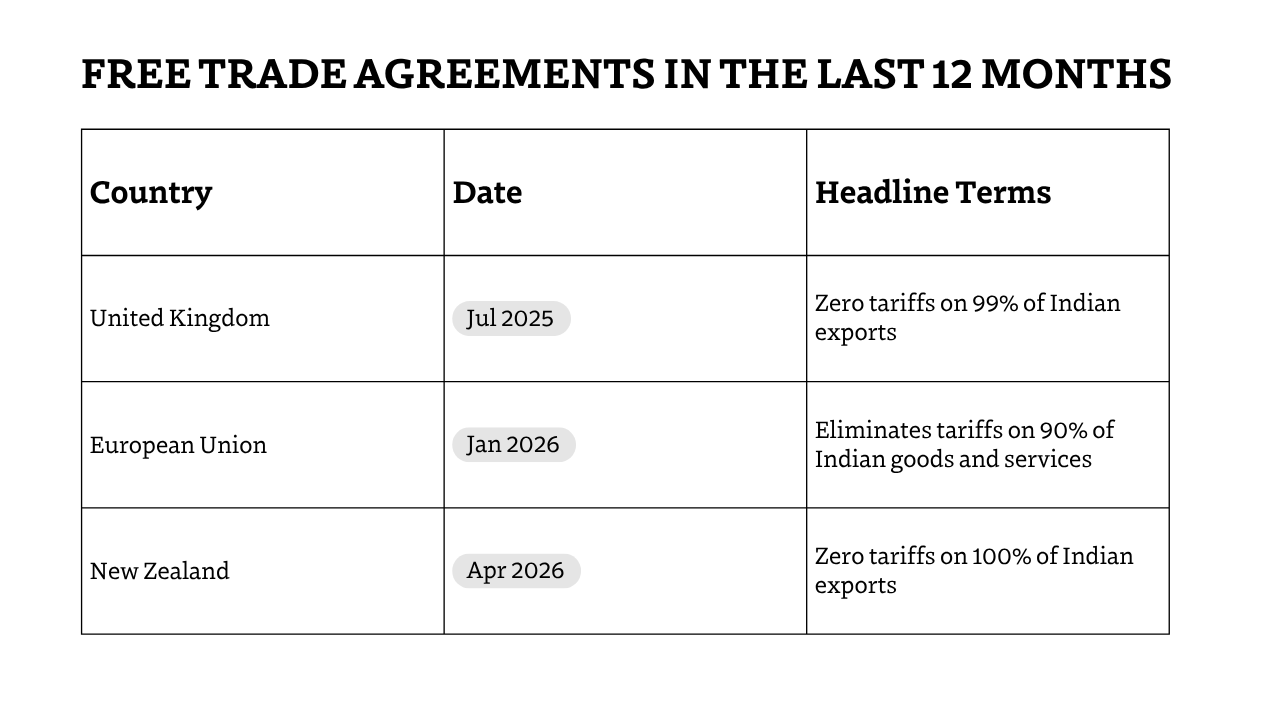
The strategic shift was symbolically evident in January 2026. During India’s Republic Day celebrations, European Union leaders were invited as chief guests—an indication of deepening alignment. The following day, India and the EU concluded what has been termed the “mother of all deals”: a Free Trade Agreement spanning nearly 2 billion people and roughly a quarter of global GDP.
The EU FTA came shortly after the India–UK FTA, signed in late 2025, which provides Indian exporters broad-based access to the UK market with significantly reduced tariffs
Beyond these, India has expanded market access through a series of agreements:
- New Zealand FTA
- Oman CEPA (Comprehensive Economic Partnership Agreement)
- UAE CEPA
- Australia FTA
At the same time, negotiations with Canada, Mexico, Peru, and Israel are in advanced stages.
Taken together, these agreements point to a clear strategic direction. India is systematically integrating with large, high-income markets—particularly in the West—while building the external demand base required to support sustained industrial growth.
In that sense, these trade partnerships are not just policy actions. They are foundational to India’s long-term economic trajectory—and central to its ambition of becoming a $30 trillion economy by 2047.
India-EU FTA
The importance of the India–EU FTA extends beyond tariffs. It creates regulatory alignment, establishes common standards, and integrates India into European supply chains at a time when global manufacturing is actively de-risking from China.
Tariff Reductions:
- EU eliminates tariffs on over 90% of Indian goods and services exported over the next decade
- India reduces tariffs on European goods, namely machinery, automobiles, and other equipment
- Immediate duty-free access for Indian textiles, leather goods, and agricultural products to EU markets
Regulatory Harmonization:
- Recognition of mutually agreed upon manufacturing standards in pharmaceuticals, chemicals, and automotive components
- Streamlined approval processes for Indian companies wanting to meet EU quality certifications
- Pathway to faster product registrations and inspections
Services and Investment:
- Easier movement of Indian IT professionals to EU countries through visa facilitation
- Ease in establishing operations in India for EU companies

The UK Deal Adds:
- Zero tariffs on 99% of Indian exports to the UK
- Mutual recognition of professional qualifications (engineering, accounting, legal services)
- Fast-track visa pathways for skilled Indian workers in shortage occupations
The EU's 450 million people represent one of the world's largest and wealthiest markets.. Preferential access to these consumers allows Indian exporters to gain scale in a meaningful way.
Sectors Poised To Benefit
• Pharmaceuticals. EU tariffs on Indian medicines (previously up to 11%) move toward zero. Mutual GMP recognition cuts inspection duplication. Companies with EU-approved facilities and pipelines in complex generics and biosimilars are best placed.
• Specialty chemicals. Indian tariffs of up to 22% on EU chemicals are nearly eliminated, and EU duties on Indian chemicals fall sharply. With Europe de-risking from China and tightening carbon border rules, REACH-compliant Indian producers gain a structural edge. The EU already absorbs ~25% of India’s organic chemical exports.
• Textiles & apparel. EU duties of 4–26% on key categories collapse to zero. ICRA and industry estimates suggest the sector could add 6–7 million jobs over the medium term. Differentiated players in technical textiles, organic cotton, and sustainable processes capture premium segments; basic-volume garment players face more pressure.
• Auto components & EVs. Tariff relief makes Indian EV components competitive against Chinese alternatives. Manufacturers meeting European safety and emissions standards gain a certification moat.
The Investor Perspective
The India-EU and UK FTAs create structural advantages for specific types of companies:
Winners:
- Export-oriented manufacturers with regulatory compliance: Pharma companies with EU GMP facilities, chemical manufacturers with REACH registrations, textile firms with sustainability certifications, auto component makers with European safety approvals
- Companies with existing EU customers: FTA deepens these ties; European buyers prioritize trusted, compliant suppliers
- Mid-sized companies scaling exports: Tariff elimination makes European expansion economically viable for smaller players previously priced out
Conclusion:
The FTAs provide Indian exporters preferential access to 500+ million high-income consumers, regulatory credibility that signals quality globally, and integration into stable, long-term supply chains providing the foundation for export-led manufacturing at scale.
For investors, the question is: which Indian companies have the compliance, customer, and capability stack that lets them win across markets — not just one?